

Will AI replace product managers? Scroll LinkedIn for five minutes and you will find a product manager worried about their job and blaming AI. The posts share a common pattern: “an LLM can write a PRD, summarize feedback, and draft a roadmap, so what is left for us?”
Short answer: no. Instead, it actually makes product managers much more effective.
But let’s be honest, if your week is mostly writing tickets, relaying messages, and updating status, that fear is reasonable. LLMs can easily replace the document creation and coordination work a lot of PMs do. But if you are the person responsible who truly understands both the technical, business, and customer sides of your product, large language models just handed you more power and influence than the role has had in years.
What a product manager is supposed to be
The job has always been demanding and difficult to hire for. A product manager is a researcher first: someone who collects information from as many sources as they can and massages that research into conclusions, which in the software world are called features. They are technical enough to talk with engineers without a translator, and business-minded enough to know whether the thing is worth building.
That is a lot to expect from one person, so in many organizations the role quietly shrank into the part that was easiest to see: coordination. Tickets, status updates, meetings, and messages passed between teams. The “product owner” title often became shorthand for that slice leaving the product manager role to interface with customers and again, pass messages between teams.
If you can’t talk to customers and interpret what they need, you can’t tell the engineers what to build and why. If you can’t communicate with engineers about the technology and how it works, you can’t interpret what customers need.
A true product manager role involves a lot of responsibilities and modern LLMs have made them much more manageable.
Where AI enables product managers
A product manager empowered by AI can be much more impactful. Here are examples of how.
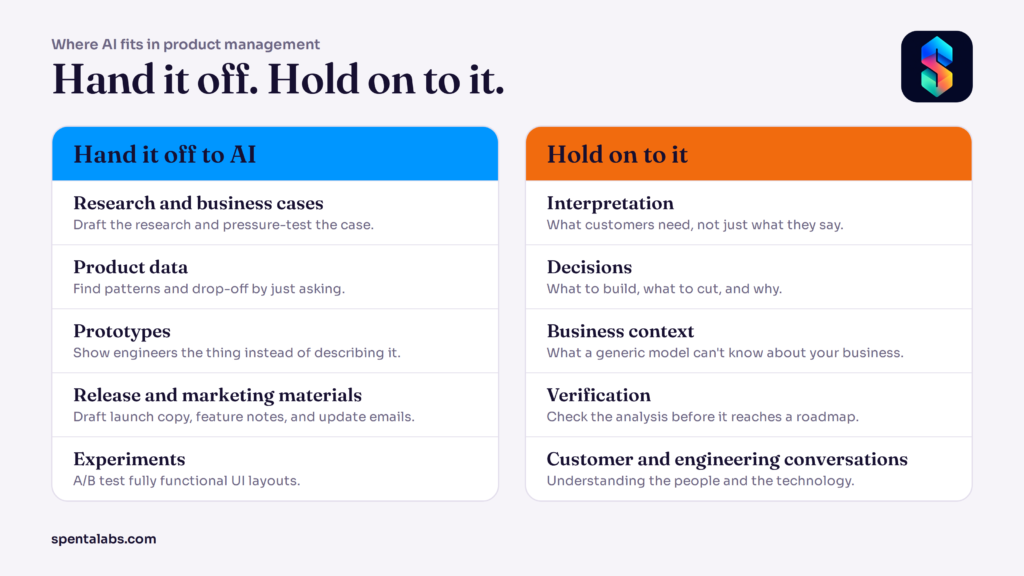
Research and business-case validation. Market scans, competitor research, and first-pass business cases used to take days. Now you can start from a well researched, AI-written draft instead of a blank page. You still decide whether the case holds.
Making sense of your product data. LLMs make it much easier to identify patterns and customer cohorts in your product data. Ask one to identify low engagement drop-off user flows or find the behavior patterns of users who cancel subscriptions, all with a plain-language request.
Prototypes instead of tickets. This is the biggest shift. I once went back and forth with a small engineering team building an onboarding experience, and things just weren’t getting implemented right. Not because the engineers were careless, actually their implementation never strayed from the ticket. The problem was all the details about UI design and user behavior that I assumed they would know and never added to the ticket.
So I spent a short time building a prototype in Lovable and attached it to the next couple of tickets. The engineers got it right on the first try. Instead of spending time interpreting my ticket, they understood the concept and details straight away and had time to make their own improvements, which is what should happen when a feature moves from product to engineering. Engineers have knowledge and skills PMs don’t, and they should be afforded the time to fill in things the PM didn’t think of.
Marketing materials. Launch copy, feature descriptions, and talking points. A PM can now hand the marketing and sales teams a strong draft to refine instead of a few bullets to interpret. Best of all, this can be entirely automated. I’ve personally set up an agent that can interpret all the user facing features by scanning the code changes for the latest release, and create customer facing product update emails.
Time for experimentation and testing. Many product teams don’t have the time or budget for proper user testing. With AI absorbing so much of the artifact creation and coordination, PMs get that time back and can expand the research behind their decisions. For example, it’s never been easier to A/B test UI layouts that are fully functional than it is today.
Where product managers go wrong with AI
The mistake I see most is using LLMs for the parts of the job where a human matters most: interpretation and decision-making.
A common example is feeding a pile of customer requests to an LLM and asking for a feature list and priorities. It is helpful, although it is usually wrong. A model reads what customers say. A PM reads between the lines to understand what they need.
On one engagement, the clients buying a company’s research asked for a dashboard to be built to display the data. After doing several interviews on how they planned to use it, we realized it is more valuable for them to be able to explore the research than to view a dashboard with predefined summary analytics.
A model summarizing this request would have prioritized building a dashboard. (We tell that story in When to Hire a Fractional Product Leader.)
A model reads what customers say.
A PM reads between the lines to understand what they need.
With more data from a wider range of customers, LLMs can do better in this scenario. But that much research is rarely available, which is why a PM has to know your business, technology, and customers well enough to be able to make a call without all the data they might need. Something a generic model will fail at. That unique context is what audience intelligence builds, and it’s why Pattern-First Discovery starts there.
Two cautions. Verify any analysis before it reaches a roadmap, and do not paste confidential customer data into public tools.
From coordinator to super power
Put together, the pattern is clear. AI does not remove the product manager it empowers that role. It removes the waiting: for research, for analysis, for someone to build a first version. A PM who can prototype, interrogate data and customers, and draft launch material can own far more of the process instead of being the communication layer between other people’s work.
Ownership has a cost, though. When you can do more of the work yourself, there are fewer places to hide, and the decisions are more clearly yours.
If you are a PM reading this here are three things to try this week:
- Take one coordination task you repeat weekly and hand the first draft to an LLM.
- Before your next feature ticket, build a rough prototype and attach it.
- Ask your data one question you have been waiting on an analyst to answer, then validate the answer.
The product managers who thrive will not be the best coordinators. They will be the drivers of the outcome.
Want a product team that works this way?
We start from patterns, prototype early, and leave your team able to run without us.