

A fractional product leader can unstick a stalled roadmap when the problem is judgment, not headcount. Here is when it works, how a pattern-first approach is different, and when to save your money.
The scarcest thing in a product organization is not talent or funding. It is judgment in the room at the moment a hard call is being avoided. Roadmaps stall for that reason. Teams ship the safe increment for that reason. Executives ask for another analysis for that reason.
That is the moment companies decide to hire a fractional product manager: a senior product leader who works with you part-time, or for a defined stretch, to set priorities, align the teams, and leave your organization able to make those calls without them.
Fractional vs. full-time vs. contractor vs. agency
These arrangements get confused constantly. The difference is who owns the decision and what is left when the engagement ends.
| Fractional product manager | Full-time PM | Contractor / staff augmentation | Agency | |
|---|---|---|---|---|
| Best for | Stalled decisions, unclear priorities, a reset or a gap while you hire | A stable product with steady, ongoing needs | Executing work that is already defined | Delivering a defined project |
| Owns the decision? | Yes, typically reporting to the CEO | Yes | Usually no, takes direction | Delivery, not your strategy |
| Time horizon | Defined up front | Open-ended | Per task or queue | Per project |
| What stays when they leave | Roadmap, processes, and playbooks documented for a permanent hire | Knowledge lives in the person | Little transfers | Deliverables, not decision-making capability |
The point of the engagement is that you do not need us indefinitely.
We step in, bring structure, transfer the knowledge, and work to make ourselves unnecessary.
Signs it’s time to hire a fractional product leader
You do not need one because product is hard. You need one when the work is stuck in a recognizable way:
- You have release problems. You do not understand your customer well enough to know what to release.
- Your product team cannot choose between competing priorities, and keeps trying anyway.
- The organization has lost trust in the product and engineering team.
- You have several disconnected solutions that will not combine into one product, one vision, or one story, which makes cross-selling hard.
- You are between hires or resetting the team and need someone senior making calls in the meantime.
Company size and stage matter less than you would expect. What matters is whether someone can make a real impact in a short window.
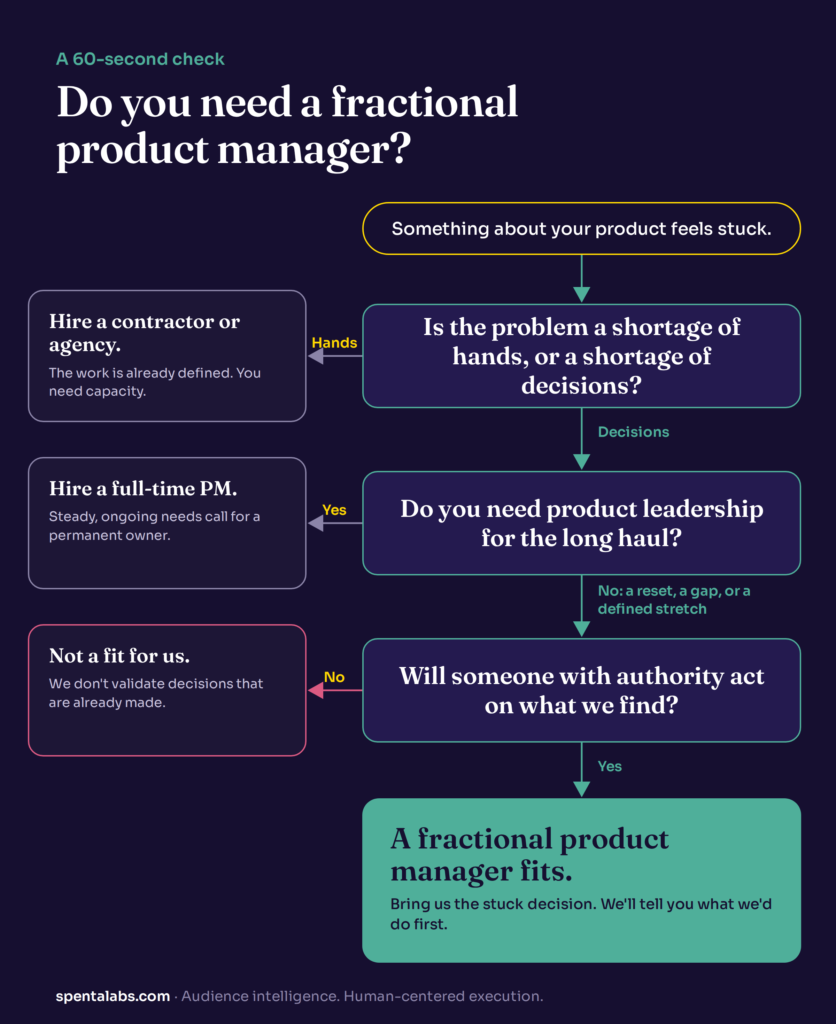
What the first stretch of an engagement looks like
The first week is diagnosis, not ceremony. Where are priorities actually set? Who can kill work? Which metrics are decorative? Which people are already doing the job without the title? You cannot roadmap your way out of a power problem. You can name it, then decide what the engagement needs to be.
From there the work gets specific. We map your customers onto behavior patterns we already understand, then run short, targeted research to find where you are different. (We explain that approach in Pattern-First Discovery.) Then we make the first real call: a roadmap reset, a prototype, a cut. We make it in public, so the team sees how the decision gets made. Along the way we write the principles down and coach the team through the first few cycles until the muscle is theirs.
Need a senior PM in the room?
Interim and fractional product leadership while you hire, reset, or get unstuck.
What makes pattern-first fractional product management different
Most fractional product managers start every engagement at zero: interviews, opinions, and a few weeks to find their footing. We start from audience intelligence, a library of how people adopt, stall, abandon, and decide, built from years of work with large consumer brands. That changes three things:
- Diagnosis is faster, because we are testing a hypothesis about your people instead of waiting for one to appear.
- Prioritization is less political, because the argument is about patterns in how your customers behave, not whose opinion is loudest.
- The call is about who actually uses the product, not just who signs the check.
We also build. Solution prototyping is part of the practice, so a decision does not die in a deck. It becomes something customers can touch. And in some partnerships we share in the licensing upside instead of only billing hours.
A real example: sales stalled at zero for eight months
A company that runs pharmaceutical clinical trials sells the analytics back to its clients. Their main product was a slide deck of insights, left behind when the work was done. New sales had stalled at zero for eight months.
Their plan was reasonable on its face: turn the slide deck into a web dashboard and hope the upgrade would attract customers.
We spent several weeks interviewing people and mapping who actually uses the analytics once they are delivered. That answer changed the plan. They sold to executives, but the people using the data were researchers, who had to produce reports regularly and keep investigating the data for other purposes long after the first presentation. A better-looking slide deck would have served neither group.
So we built something different. Instead of a dashboard that displays surface-level analytics, clients can interview the entire dataset, by text or voice, and get responses that speak as the target subject of the clinical trial would. We had a prototype within several weeks, then a bit longer to harden it into a production-quality product that fit with their other offerings. We ran the first demos ourselves until the partner could manage it on their own.
Clients were not expecting it, and they got excited. After eight months at zero, new deals closed with existing clients, the lowest-hanging fruit. One client described it as finally putting to work ten years and millions of dollars of research that no one looked at after the first presentation. We were already finding new opportunities for the solution.
Notice what happened. The pattern showed us that the buyer and the user were different people with different jobs. That is a product-management insight, not a design tweak. It is the kind of call a fractional product leader exists to make: not the one the team asked for, but the one the customers’ behavior pointed to.
What you are left with when we leave
A fractional engagement succeeds when your company needs nothing from us to keep going. By the end, you should have:
- A roadmap with strategy and vision built in, including go-to-market (sales and, where relevant, marketing)
- Updated, documented processes and workflows for product, UX and design, and any team we manage
- A team growth plan
- A decision log: what we chose, what we cut, and why
- A library of your customer patterns, so the next person starts from evidence
- A handoff package a permanent hire can step into without a gap
The target is enough clarity to run the next three to five years without us on staff.
When not to hire us
Do not hire us to validate a decision that is already made. Do not hire us to be the villain in someone else’s story so leadership can stay likable. Do not hire us if the real request is a staff-augmentation ticket queue with a senior title on the invoice. We do the work that transfers judgment. We will not decorate a process designed to avoid it.
Do hire us when the room is stuck, the people are real, and someone is willing to be changed by what we find.
Fractional product leader FAQ
Who does a fractional product manager report to?
Typically the CEO.
How long does an engagement last?
Typically six months, and three years at the outside. We prefer situations where meaningful impact is possible in a short period.
Does company size or stage matter?
Less than the situation does. What matters is whether the problem is one a product leader can move quickly.
How is it priced?
We scope the work up front and price against that scope. In some partnerships, like the one above, we have also taken a share of licensing revenue instead of only billing hours.
Can you build as well as advise?
Yes. Solution prototyping is part of what we do, which is how the example above went from interviews to a working prototype in weeks.
Tell us what is stuck.
Bring the decision, the stalled roadmap, or the product your own sales team cannot explain. We typically reply within a business day with thoughts, not a script. If we are not the right fit, we will say so. That is also judgment.